What Is Tertiary Filtration and Why Does It Matter in STP Fundamentals?
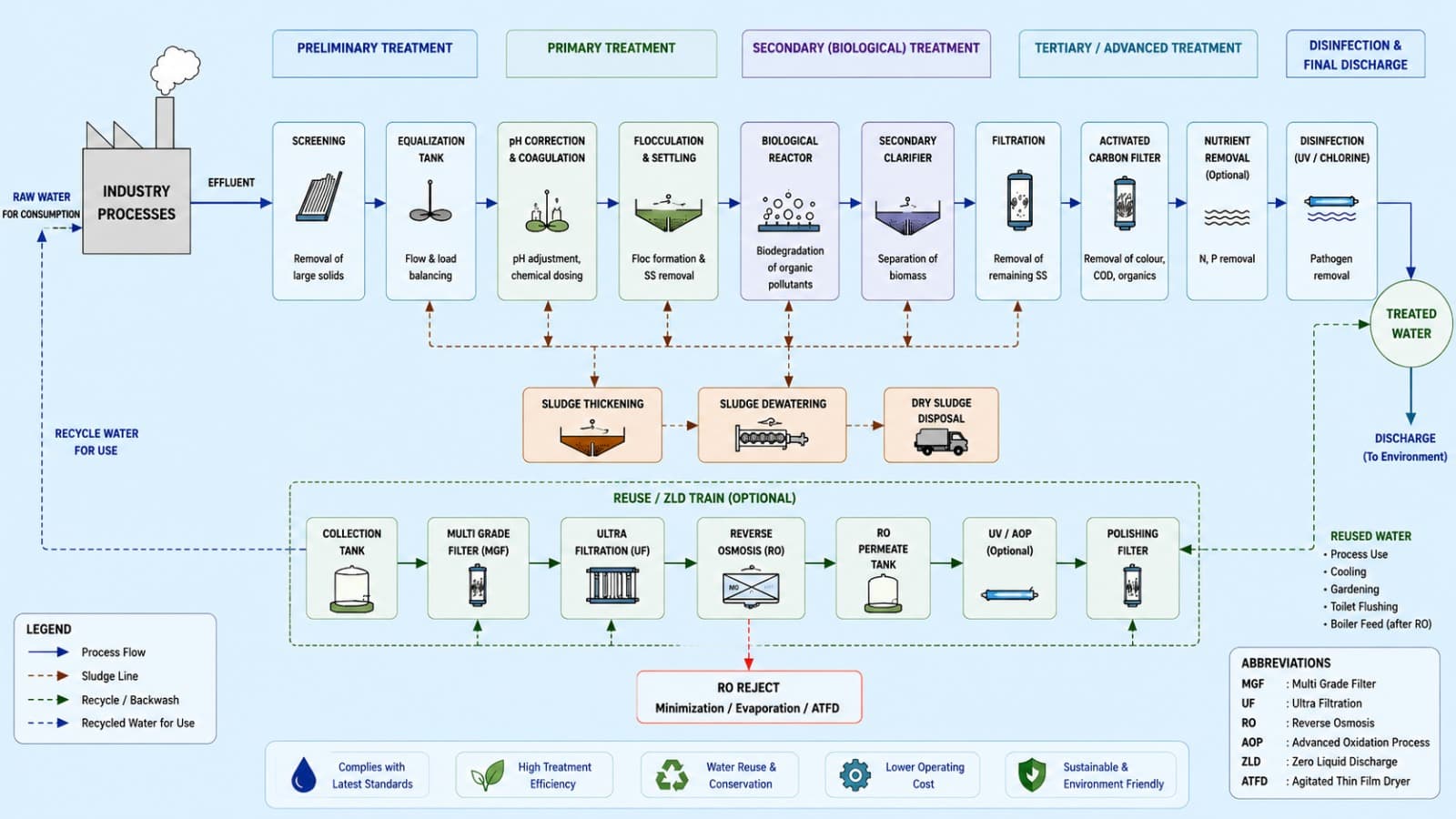
A Sewage Treatment Plant (STP) treats domestic and sanitary wastewater to make it suitable for discharge or reuse, depending on the required quality standards. While primary and secondary treatment remove a significant portion of suspended solids and organic pollutants, some fine particles may remain in the treated water.
Tertiary filtration is an additional treatment stage used to remove residual suspended solids and improve the clarity and quality of treated wastewater before its final discharge or reuse.
For industries, commercial buildings, residential complexes, hospitals and institutional facilities across India, effective tertiary filtration can support more reliable STP performance and water-reuse objectives.
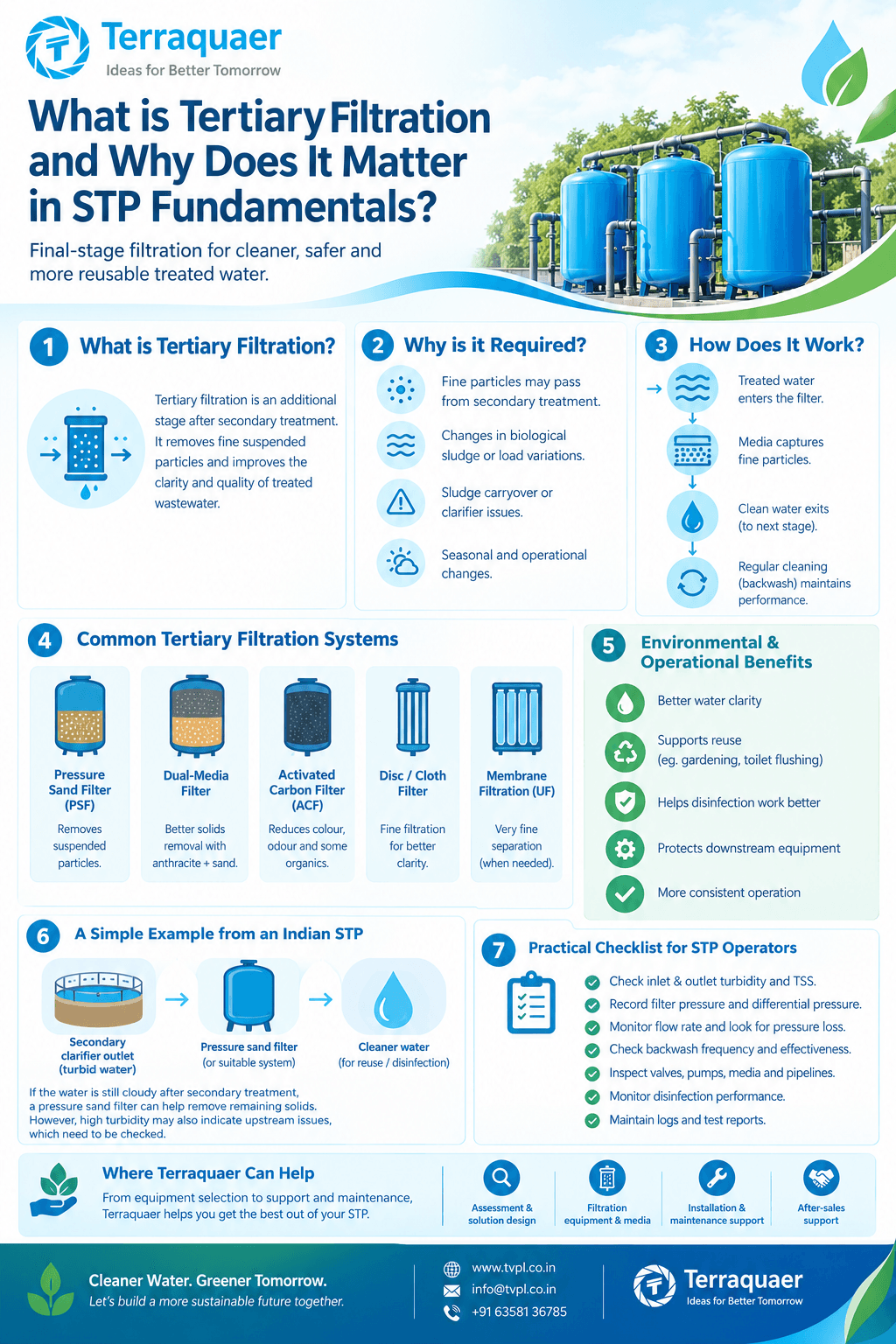
What Is Tertiary Filtration?
Tertiary filtration is a polishing process generally provided after secondary biological treatment and clarification. It captures fine suspended particles that may pass through earlier treatment stages.
Depending on the treated water quality and intended application, common filtration systems include:
- Pressure Sand Filters (PSF): Remove suspended particles through a granular filter bed.
- Dual-Media Filters: Use layers such as anthracite and sand to improve solids removal.
- Activated Carbon Filters (ACF): Help reduce certain dissolved organic compounds, colour and odour.
- Disc or Cloth Filters: Provide fine-particle filtration in suitable applications.
- Membrane Filtration: UF membranes can provide finer separation when the application requires it.
The appropriate technology depends on the inlet water quality, required outlet parameters, available space, operating costs and intended reuse.
Why Is Tertiary Filtration Required?
Even a properly operated secondary treatment system may leave residual solids in the outlet water.
Common reasons include:
- Fine suspended particles escaping the secondary clarifier.
- Poor settling caused by changes in biological sludge characteristics.
- Hydraulic surges or sudden variations in wastewater loading.
- Sludge carryover due to clarifier or sludge-return problems.
- Seasonal and operational changes affecting treatment performance.
Tertiary filtration helps manage residual particles, but it should not be used as a substitute for correcting poor biological treatment or clarification.
How Does Tertiary Filtration Work?
The filtration process generally follows these steps:
- Treated water enters: Secondary-treated wastewater flows to the filtration unit.
- Particles are captured: The filter media or filtration surface retains suspended solids.
- Filtered water exits: The treated outlet is monitored against the required quality parameters.
- Filter cleaning takes place: Backwashing or another suitable cleaning method restores filtration performance.
- Water moves to the next stage: Depending on the application, it may undergo disinfection, further polishing, storage or reuse.
The filter must be operated at the recommended flow rate and cleaned according to differential pressure, outlet quality and equipment requirements.
Environmental and Operational Benefits
Well-designed tertiary filtration can provide several practical benefits:
- Better water clarity: Reduces residual suspended particles when operated correctly.
- Improved reuse potential: Supports applications such as toilet flushing, gardening and suitable utility uses, subject to the required water quality.
- Support for disinfection: Lower suspended-solids levels can improve disinfection effectiveness in suitable systems.
- Protection of downstream equipment: Reduces solids loading on subsequent treatment units.
- More consistent operation: Helps manage variations in residual solids when upstream treatment is functioning properly.
Tertiary filtration alone does not guarantee the removal of dissolved salts, pathogens or all chemical contaminants. Additional treatment and testing may be necessary for specific reuse requirements.
A Practical Example from an Indian STP
Consider an STP serving a commercial building or industrial facility where secondary-treated water is intended for toilet flushing and landscape irrigation.
The secondary clarifier outlet appears slightly turbid, and the treated water contains more suspended solids than expected. These solids may affect the appearance of stored water and increase the load on downstream disinfection.
A properly selected pressure sand filter, followed by suitable disinfection, may help reduce residual suspended solids and improve the consistency of the treated water.
However, if turbidity rises because of sludge carryover from the clarifier, the upstream problem must also be investigated. Filtration performance should be verified through actual operating data and water-quality testing.
Practical Checklist for STP Operators
Use this checklist during routine plant operation:
- Check inlet and outlet turbidity and TSS (Total Suspended Solids), where applicable.
- Record filter inlet and outlet pressure and differential pressure.
- Monitor flow rate and look for unexpected pressure loss or reduced output.
- Check backwash frequency, duration and effectiveness.
- Inspect valves, pumps, filter media and associated pipelines.
- Monitor disinfection performance and the quality required for the intended reuse.
- Investigate sudden changes in outlet quality rather than relying only on filtration.
- Maintain operating logs, maintenance records and laboratory test reports.
Testing frequency and acceptance limits should follow the applicable consent conditions, reuse requirements and site-specific operating procedures.
Where Terraquaer Can help
Terraquaer supports water and wastewater treatment requirements through practical engineering, equipment selection and operational support.
Depending on the project, support may include:
- Assessment of existing STP performance and outlet-water quality.
- Selection of suitable tertiary filtration equipment and filter media.
- Supply of filtration consumables, valves and associated equipment.
- Review of filtration flow rates, pressure conditions and backwash requirements.
- Support for downstream disinfection and treated-water reuse arrangements.
- Maintenance guidance, troubleshooting and after-sales support.
The final selection should be based on wastewater characteristics, treatment objectives, site conditions and the required treated-water quality.
Conclusion
Tertiary filtration is an important polishing stage in many STP applications. By reducing residual suspended solids, it can improve treated-water clarity and support appropriate reuse and disinfection processes.
The best results come from combining suitable filtration equipment with effective upstream treatment, regular monitoring and timely maintenance.
Planning an STP upgrade or looking to improve treated-water quality?
Connect with Terraquaer to discuss your filtration requirements and identify a suitable treatment approach.