ETP Equalization Tank Design: Flow, pH, Shock Loads and Mixing

An ETP equalization tank is where unstable industrial wastewater becomes a controllable treatment feed. When flows, pH, temperature, COD, colour, salts or oil loads swing across a shift, equalization protects downstream clarification, biological treatment, membranes and compliance performance.
What an ETP Equalization Tank Does
Equalization collects wastewater from selected drains, blends short-term variations and feeds the treatment train at a controlled rate. It does not remove every pollutant; its primary job is hydraulic and load buffering. With appropriate mixing and monitoring, operators can see a representative inlet condition and respond before a shock load reaches chemical dosing, clarifiers or aeration.
Why Flow and Load Equalization Matter
Average daily flow alone is not a design basis. Batch dumping, CIP cycles, equipment washdowns, shifts, rain ingress and intermittent process drains can create peak hydraulic flow and peak mass load that are far above the average. A tank that only matches average flow can still pass an untreated shock downstream. Design therefore starts with time-based flow data, a process water balance and representative wastewater sampling—not a nameplate capacity assumption.
The Four Inputs That Set Tank Volume
1. Inflow profile: record hourly or shorter-interval flow over typical and high-production days. 2. Influent quality profile: map pH, COD, BOD, TSS, TDS, colour, oil and grease, temperature and process-specific contaminants by stream and time. 3. Required downstream feed: establish the stable flow rate and load that clarification or biological treatment can accept. 4. Operating margin: allow for campaign changes, maintenance and credible upset conditions. Tank volume is then calculated from the cumulative difference between variable inflow and controlled outflow, with an engineered freeboard and operating range.
Separate Streams Before You Blend Them
Segregation is often more valuable than simply making the tank larger. Keep concentrated mother liquors, spent solvents, high-TDS streams, acidic or alkaline batches, oily wastewater, toxic cleaning streams and relatively clean utility water identifiable until their treatment route is confirmed. Blending an inhibitory stream into a common equalization tank can convert a manageable side stream into a plant-wide biological or membrane problem. Treatability review should determine what can be equalized together.
pH Correction: Control the Reaction, Not Just the Reading
A single pH number at the tank outlet can hide poor mixing or delayed chemical reaction. Provide a representative measurement location, adequate contact time, compatible materials of construction, dosing interlocks and safe acid/alkali storage. Where acidic and alkaline streams occur in batches, controlled sequencing or separate holding may be safer than relying on uncontrolled neutralization. Verify the target pH against the next unit operation and the applicable consent condition.
Mixing, Aeration and Odour Control
Mixers are selected to prevent solids deposition and maintain representative sampling without creating excessive vortexing or foam. Coarse-bubble air may help with mixing and odour management where compatible with the wastewater, but it is not a substitute for process design; aeration can alter oxidation state, strip volatile compounds or create foam. The mixer duty, tank geometry, baffles, suction location and access for maintenance must be designed together.
Instrumentation and Operating Discipline
A practical equalization system normally includes level indication, controlled transfer pumping, overflow and low-level protection, pH monitoring and a representative sampling point. Flow measurement and trend logging make it possible to compare production events with wastewater response. Where consent conditions or site requirements call for it, instrumentation and monitoring arrangements should be confirmed against the applicable CPCB/SPCB requirements and the facility’s consent-to-operate conditions.
How Equalization Protects Downstream ETP Units
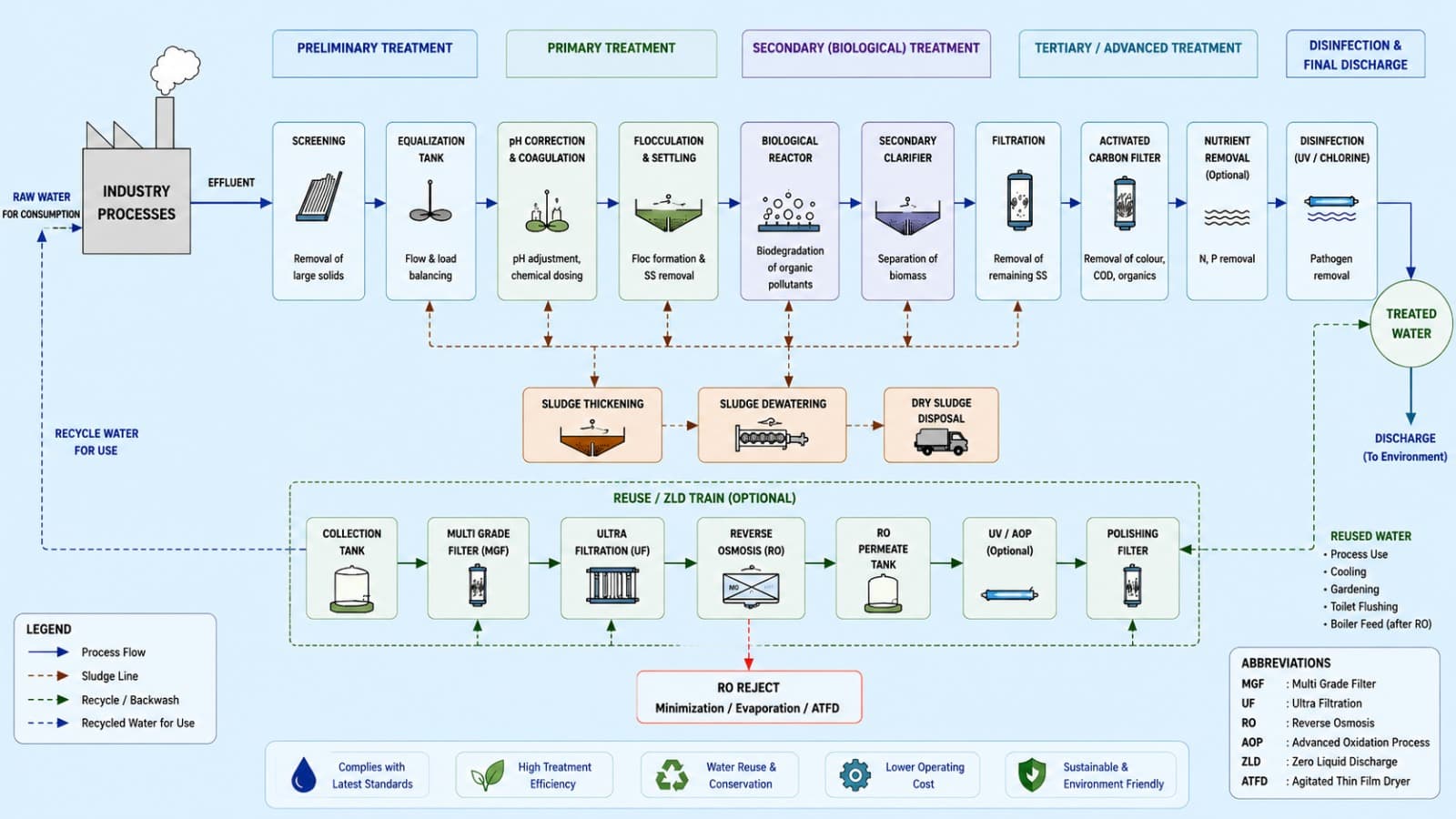
Stable feed improves coagulant and polymer response, clarifier settling, biological loading, dissolved-oxygen control, filter run time and membrane reliability. It also reduces emergency chemical use and helps operators distinguish a genuine treatability issue from a short-duration inlet upset. Equalization therefore improves the whole treatment train, including ETP revamps, water-reuse systems, RO pretreatment and ZLD front ends.
Common Design and O&M Mistakes
Frequent failure points are designing on average flow only; letting stormwater enter process drains; omitting a mixer or providing an inaccessible one; dosing chemicals without interlocks; sampling from a dead zone; allowing sediment to accumulate; and treating the equalization tank as a dump tank rather than an actively managed process unit. A site review should also check ventilation, chemical safety, pump redundancy, cleaning access, civil condition and operator routines.
A Commissioning Checklist
Before performance trials, verify drainage segregation, actual pump curves, level controls, mixer rotation, pH calibration, dosing response, sample-point representativeness, sludge or grit removal arrangements, high-level alarms and downstream feed stability. Trial the plant across a normal production cycle and a known peak period. Use the results to tune transfer rates and chemical-control logic before accepting the final operating set points.
Terraquaer’s EPC, EPCC and Lifecycle Support
Terraquaer designs ETP equalization and complete industrial wastewater treatment systems from wastewater characterization and water balance through process selection, detailed engineering, equipment supply, installation, automation, commissioning, revamping and O&M support. Our ETP, chemical dosing, clarifier, MBBR, MBR, UF, RO and ZLD capabilities are combined only where the wastewater data, reuse objective and lifecycle cost justify them.
Plan the Equalization Tank Before the Next ETP Upgrade
For a new ETP or a troubled existing plant, start with a measured flow-and-quality profile, a stream-segregation map and the required discharge or reuse target. Terraquaer can review the bottleneck, propose an engineered equalization and treatment route, and support implementation through EPC/EPCC delivery and long-term operation support.