How TDS is Handled: Equipment, Process & Operator Checks
Maintaining the right Total Dissolved Solids (TDS) level is one of the most important aspects of industrial water treatment. Whether the application is in pharmaceuticals, food processing, textiles, power plants, or commercial buildings, controlling TDS helps improve water quality, protect equipment, and ensure smooth plant operations.
At Terraquaer Venture Private Limited, we provide reliable water treatment solutions that combine the right equipment, efficient processes, and disciplined operator practices to achieve consistent TDS control.
What is TDS?
Total Dissolved Solids (TDS) refers to the total amount of dissolved minerals, salts, metals, and other inorganic substances present in water. While some dissolved minerals are naturally present, excessive TDS can create several operational problems such as:
- Scaling inside pipelines and heat exchangers
- Membrane fouling
- Reduced equipment efficiency
- Higher maintenance costs
- Poor process water quality
- Increased energy consumption
Proper TDS management helps industries maintain operational efficiency while meeting water quality standards.
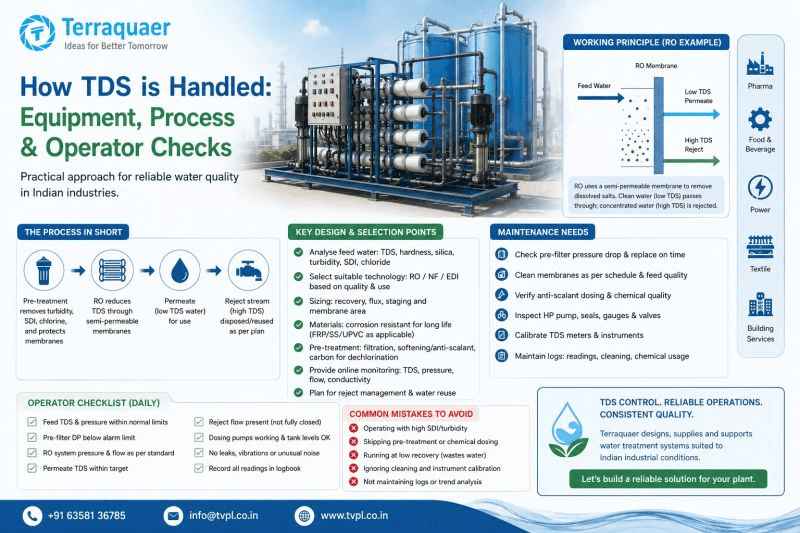
The TDS Treatment Process
An effective water treatment system removes dissolved impurities through a systematic treatment process.
1. Pre-Treatment
The incoming water first passes through pre-treatment systems that remove suspended solids, chlorine, and other contaminants.
Typical equipment includes:
- Sand Filters
- Activated Carbon Filters
- Cartridge Filters
- Chemical Dosing Systems
Proper pre-treatment protects downstream membranes and extends their service life.
2. Reverse Osmosis (RO)
The heart of TDS reduction is the Reverse Osmosis (RO) system.
RO membranes allow clean water to pass through while rejecting dissolved salts and impurities. This process separates the feed water into:
- Permeate: Low TDS purified water
- Reject Water: High TDS concentrate containing dissolved contaminants
The treated water can then be used for industrial processes, utilities, or further purification if required.
Equipment Required for Effective TDS Control
Selecting the right equipment is critical for long-term performance.
Common components include:
- Pre-treatment filtration systems
- RO membranes
- High-pressure pumps
- Pressure vessels
- Flow meters
- Conductivity/TDS meters
- Pressure gauges
- Chemical dosing systems
- Control panels and automation
Each component plays an important role in ensuring stable water quality and reliable plant performance.
Key Design Considerations
Every industry has different water quality requirements. A properly designed system considers:
- Raw water TDS levels
- Required treated water quality
- Plant recovery percentage
- Flow rate requirements
- Membrane selection (RO, NF, UF where applicable)
- Material compatibility
- Chemical dosing requirements
- Future expansion possibilities
Correct system design reduces operating costs and improves equipment life.
Operator Checks That Matter
Even the best equipment requires regular monitoring by trained operators.
Daily checks should include:
- Monitor feed water TDS
- Record permeate TDS
- Check operating pressure
- Verify flow rates
- Inspect pumps for abnormal noise or vibration
- Check for leakages
- Ensure dosing pumps are functioning correctly
- Maintain operation logbooks
Routine monitoring helps identify issues before they become major failures.
Preventive Maintenance Practices
Preventive maintenance ensures consistent TDS performance and reduces unexpected downtime.
Recommended activities include:
- Replace pre-filter cartridges on schedule
- Clean RO membranes as recommended
- Calibrate TDS meters periodically
- Inspect pumps, valves, and pipelines
- Verify anti-scalant dosing
- Check instrument accuracy
- Maintain proper cleaning records
A planned maintenance schedule significantly improves membrane life and plant reliability.
Common Mistakes That Affect TDS Performance
Many water treatment systems experience performance issues because of avoidable operational mistakes.
Some common examples are:
- Operating with high SDI (Silt Density Index)
- Delaying cartridge filter replacement
- Ignoring membrane cleaning schedules
- Incorrect chemical dosing
- Running the system beyond recommended recovery
- Poor record keeping
- Ignoring increasing permeate TDS trends
- Operating with faulty sensors or instruments
Correcting these issues early prevents costly breakdowns and maintains consistent water quality.
Industries That Benefit from Proper TDS Management
Reliable TDS control is essential across multiple sectors, including:
- Pharmaceutical manufacturing
- Food & beverage processing
- Textile industries
- Power plants
- Chemical industries
- Commercial buildings
- Engineering industries
Each application requires water quality suited to its specific process requirements.
Why Choose Terraquaer?
At Terraquaer Venture Private Limited, we provide complete water treatment solutions designed for long-term performance. From system design and equipment selection to installation, commissioning, maintenance, and technical support, our focus is on delivering reliable and efficient treatment systems that meet industrial requirements.
Our expertise includes:
- Water Treatment Plants (WTP)
- Reverse Osmosis (RO) Systems
- Sewage Treatment Plants (STP)
- Effluent Treatment Plants (ETP)
- Zero Liquid Discharge (ZLD) Systems
- Membrane Technologies
- Chemical Dosing Systems
- Pumps, Blowers & Process Equipment
Conclusion
Effective TDS management is not achieved by equipment alone. It requires the right combination of proper system design, quality components, routine maintenance, and disciplined operational practices. By monitoring key parameters and following preventive maintenance schedules, industries can improve water quality, extend equipment life, reduce operating costs, and ensure uninterrupted plant performance.
If you're planning a new water treatment system or looking to optimize an existing plant, Terraquaer Venture Private Limited can help you implement reliable and efficient TDS management solutions tailored to your industrial needs.