Choosing between MBR and MBBR for retrofit projects
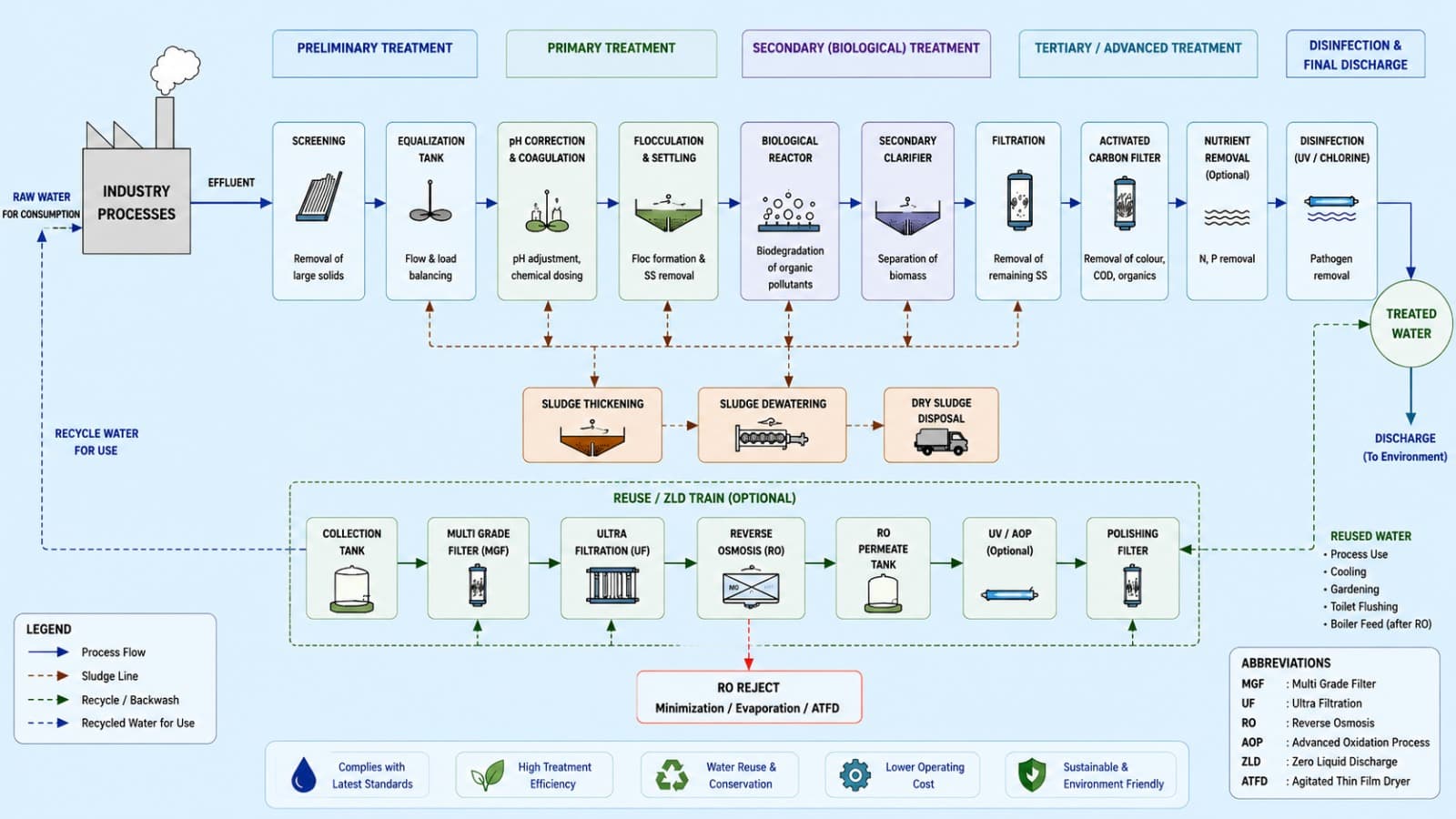
When a plant operator needs to retrofit an existing STP or ETP biological stage - whether to meet tighter effluent norms, increase hydraulic throughput, or enable treated-water reuse - the first technology question is almost always MBR versus MBBR. Both improve on conventional activated sludge in footprint and effluent quality; they do so through different mechanisms, with different cost profiles, different operator demands, and different vulnerability profiles under variable loading. The right answer depends on a specific set of site parameters, not on a general preference for one technology.
What each technology does and where it wins
MBR (Membrane Bio-Reactor) combines a biological aeration tank operating at high MLSS (typically 8,000-12,000 mg/L) with submerged ultrafiltration membranes (hollow-fibre or flat-sheet, pore size 0.04-0.4 micron) that retain all suspended solids and most pathogens. The result is consistently high-quality effluent: BOD typically < 5 mg/L, TSS < 1 mg/L, turbidity < 1 NTU. MBR is the correct choice when the downstream reuse requires cooling tower make-up, near-potable polishing, or MoEF&CC-grade discharge into water bodies with strict suspended-solids and pathogen limits.
MBBR (Moving Bed Bio-Reactor) grows a fixed biofilm on plastic carrier media circulating in the aeration tank. Protected surface area on standard K-series carriers runs from 500 sq.m/cu.m (K1) to 900 sq.m/cu.m (BiofilmChip), with fill ratios between 40% and 67% of reactor volume. Effluent from MBBR requires a downstream clarifier and, for reuse, a sand filter and UV disinfection - reaching BOD < 10 mg/L, TSS < 10 mg/L with a properly designed post-treatment train. MBBR wins where the footprint constraint is moderate, the reuse target is flushing or irrigation-grade, and the operator team lacks skills to manage membrane cleaning cycles.
Retrofit-specific constraints that change the answer
In a greenfield selection, these factors are straightforward. In a retrofit, three constraints regularly shift the decision. First, existing tank geometry: MBR requires adequate submergence depth (minimum 2.5 metres for flat-sheet cassette installations, minimum 3.0 metres for hollow-fibre modules). If the existing aeration tank is shallow, the structural cost of deepening it can make MBR uncompetitive. MBBR retrofit involves installing carrier media and adjusting diffuser placement in the existing tank with minimal structural modification, provided blower capacity can be matched.
Second, sludge yield and disposal cost: MBR at high MLSS operates at longer sludge retention times (SRT typically 15-25 days), reducing net sludge yield - typically 0.05-0.15 kg VSS/kg BOD at SRT > 20 days versus 0.3-0.4 kg VSS/kg BOD for conventional ASP. At sites where sludge disposal is expensive or subject to specific characterisation requirements, the lower MBR sludge yield is a meaningful operating cost advantage. Third, operational variability: MBR membranes foul progressively under sustained flux above the critical threshold (typically 15-25 LMH for hollow-fibre in municipal sewage), inadequate scouring airflow, or cleaning cycles falling behind fouling rate. Recovery from fouling requires extended chemical soaking (2-4 hours offline per train per event). MBBR media does not require chemical cleaning.
Cost framing for the retrofit decision
On a 10-year lifecycle basis for a 200 KLD retrofit: MBR capital cost (including membranes, blowers, control panel) typically runs 25-35% higher than MBBR for equivalent hydraulic throughput, narrowing to 15-20% when the MBBR's required clarifier and media are factored in. The dominant lifecycle cost differential is membrane replacement - hollow-fibre modules have a typical service life of 7-10 years in well-operated domestic sewage, shorter (4-6 years) in industrial or mixed streams with surfactants. At current market pricing, a 200 KLD MBR carrying two replacement cycles over 10 years adds approximately Rs. 35-50 lakhs in replacement cost that MBBR does not incur. Whether that differential is offset by the higher reuse-water quality and lower sludge disposal cost depends on the specific plant's reuse application and sludge disposal route.