Activated Sludge Bulking in ETP and STP: SVI, Settleability and Recovery Guide
Poor sludge settling can turn an otherwise healthy ETP or STP into a compliance and reuse risk. When mixed liquor leaves the clarifier with solids carryover, operators need a disciplined diagnosis—not a one-variable correction. This guide explains how to investigate activated-sludge bulking and weak settleability using field observations, 30-minute settling, SVI, DO profiles, solids inventory and influent data.
What sludge bulking means in an ETP or STP
Bulking is poor settling caused by light, open or filament-dominated floc. It may appear as a rising sludge blanket, cloudy clarifier overflow, slow compaction in a settleometer or elevated suspended solids in the outlet. It is a settling symptom, not a single diagnosis: low oxygen, changing load, nutrient imbalance, toxic shocks, septicity, hydraulic upsets and solids-age drift can produce similar outcomes.
Start with a safe, repeatable observation set
- Record influent flow, pH, conductivity, COD/BOD and temperature by shift; compare the event to normal production or occupancy.
- Run a 30-minute mixed-liquor settle test at a consistent sample point and time; photograph the settling curve and note supernatant clarity.
- Trend MLSS or MLVSS, SVI, sludge-blanket depth, RAS rate and WAS rate together—not as isolated readings.
- Log dissolved oxygen across the aeration basin and across the day. A single reading can miss peak-load or overnight low-DO periods.
- Inspect aeration headers, diffusers, blower loading, foam, odour, scum, clarifier hydraulics and RAS pumping before altering chemistry.
Read the signals together
SVI relates the settled sludge volume after 30 minutes to mixed-liquor suspended solids. It is useful for trending compaction, but it must be interpreted with MLSS, settleometer appearance and clarifier performance. A sudden SVI rise after a load or pH event calls for source investigation; a gradual shift can indicate solids-age, oxygen-transfer or biomass-selection changes. Site-specific baselines matter more than copying a target range.
Common root-cause paths
1. Oxygen-transfer or mixing limitations
Low or uneven DO can favour filamentous growth and suppress treatment capacity. Check the full DO profile, blower capacity and turndown, air-header balance, diffuser fouling, valve positions, mixing and peak organic loading. Restore reliable oxygen transfer and mixing; do not compensate for an aeration fault solely by increasing RAS.
2. Solids inventory and wasting control
Too much or too little solids, a changing sludge age, or unplanned WAS interruptions can destabilise floc quality. Reconcile MLSS inventory with RAS and WAS volumes, then adjust wasting gradually against the plant’s design, process objective and observed trend. The target solids-retention time depends on temperature, treatment configuration and required nutrient removal.
3. Influent shocks, septicity and nutrient balance
Batch discharges, pH excursions, solvent or biocide carryover, sulphide/septic streams and abrupt COD changes can disrupt biomass. Confirm equalization performance, source segregation and pretreatment controls. For industrial wastewater, nutrient requirements and toxicity tolerance must be evaluated from actual wastewater characterisation rather than assumed ratios.
4. Clarifier and return-sludge constraints
A biological issue can be amplified by blanket accumulation, short-circuiting, poor weir condition, scum control, RAS-pump limitations or excessive hydraulic loading. Inspect both biology and hydraulics. A stable aeration basin cannot protect effluent quality if solids are not captured and returned reliably.
A practical recovery sequence
- Stabilise safety and compliance: increase sampling, protect reuse distribution where quality is uncertain, and document the event.
- Confirm the measurement system: calibrated DO meter, consistent settle test, representative MLSS sample and verified flow/chemical-dosing data.
- Remove obvious mechanical constraints in aeration, mixing, clarifier and RAS/WAS handling.
- Trace process change against influent events, production schedule and operating changes; make one controlled adjustment at a time.
- Use microscopy, jar/settling tests and specialist process review when the mechanism remains uncertain or solids loss persists.
- Verify recovery through multiple stable operating cycles before reducing monitoring frequency.
Terraquaer’s EPC, EPCC and O&M role
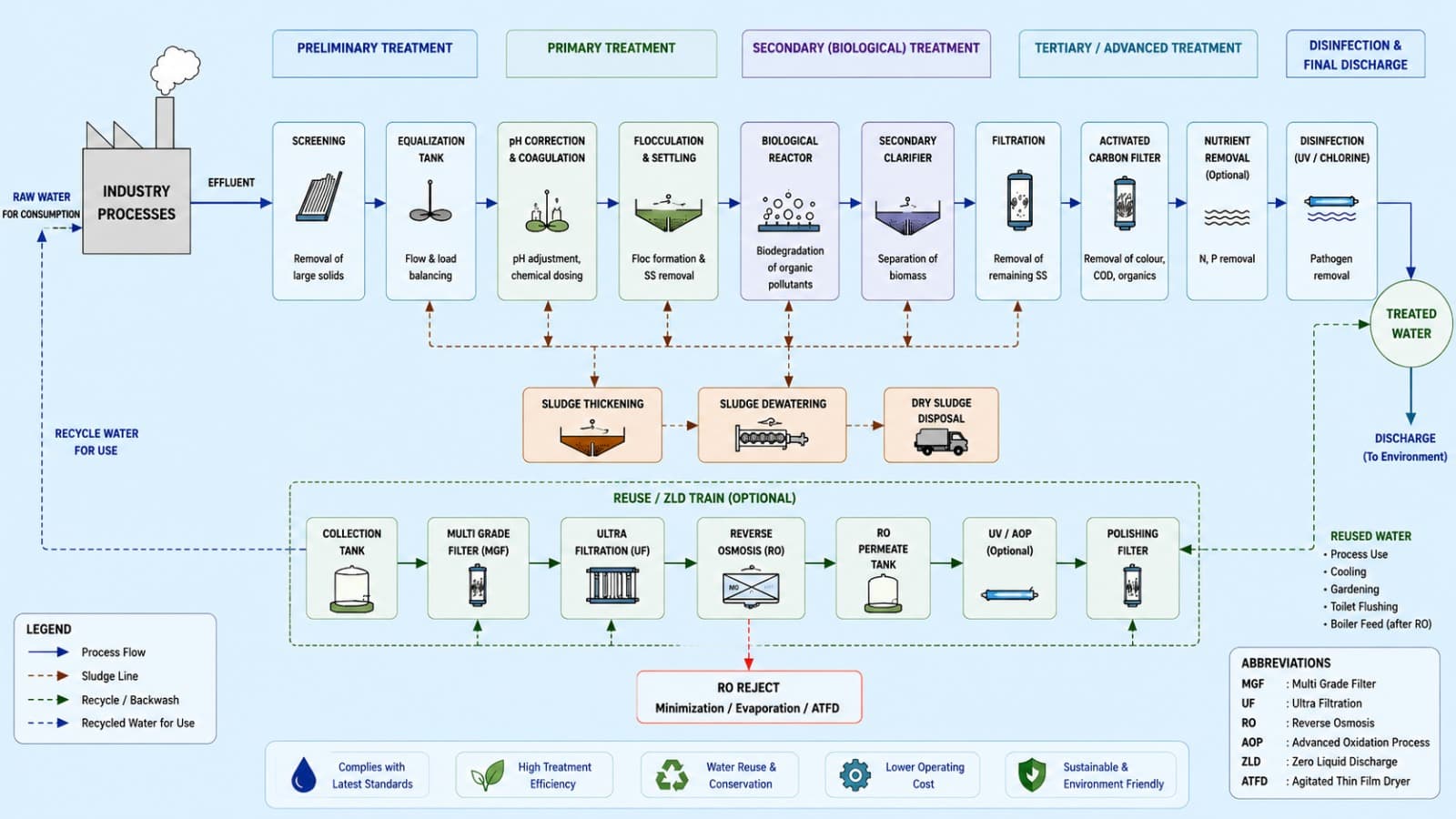
Terraquaer can assess activated-sludge performance from influent equalization through aeration, clarification, sludge handling and reuse polishing. For EPC or EPCC projects, the team can align process selection, equipment, instrumentation, piping and commissioning controls with the wastewater profile. Under O&M support, Terraquaer can help build shift-wise monitoring routines, troubleshoot aeration and solids handling, optimise chemical and wasting controls, and document corrective actions for site-specific consent and compliance obligations.
FAQ
When should an operator investigate sludge bulking?
Investigate when settleability, SVI trend, blanket depth, solids carryover, effluent suspended solids, foam or outlet clarity departs materially from the site baseline. Escalate quickly when compliance or reuse quality is at risk.
Can a higher RAS flow solve bulking sludge?
RAS changes may affect blanket control, but they do not correct the underlying biological, oxygen-transfer, loading or hydraulic cause. Confirm the diagnosis before changing RAS and track the effect with consistent measurements.
Is one DO reading enough to rule out an aeration problem?
No. DO can vary across basins and during load peaks, shifts and low-flow periods. A profile or logged trend is more useful than a single spot reading.
Are SVI targets universal?
No. The most useful control is a site-specific baseline paired with MLSS, settling appearance, treatment objective and clarifier response. Design and operating conditions differ by process and wastewater.