

Overview
Product Overview
Clarifiers are essential equipment used in water and wastewater treatment plants for separating suspended solids, sludge and other settleable impurities from water through the process of sedimentation. They are specially designed to reduce the suspended solid concentration in water, improve water clarity and ensure efficient downstream treatment.
At Terraquaer Venture Private Limited, we offer engineered clarifier systems designed to deliver reliable, efficient and continuous solid-liquid separation for industrial and municipal water treatment applications.
Our clarifiers utilize the principle of gravity settling, allowing heavier suspended particles to settle at the bottom of the tank while clarified water is collected from the upper section through specially designed outlet arrangements. The settled sludge is continuously or periodically removed using mechanical sludge collection mechanisms.
Designed with a focus on operational efficiency, durability and treatment performance, our clarifier systems can be customized according to wastewater characteristics, treatment capacity, site conditions and specific industrial requirements.
Working Principle of Clarifiers
Clarifiers operate on the principle of gravity sedimentation, in which suspended particles separate from water based on their settling characteristics.
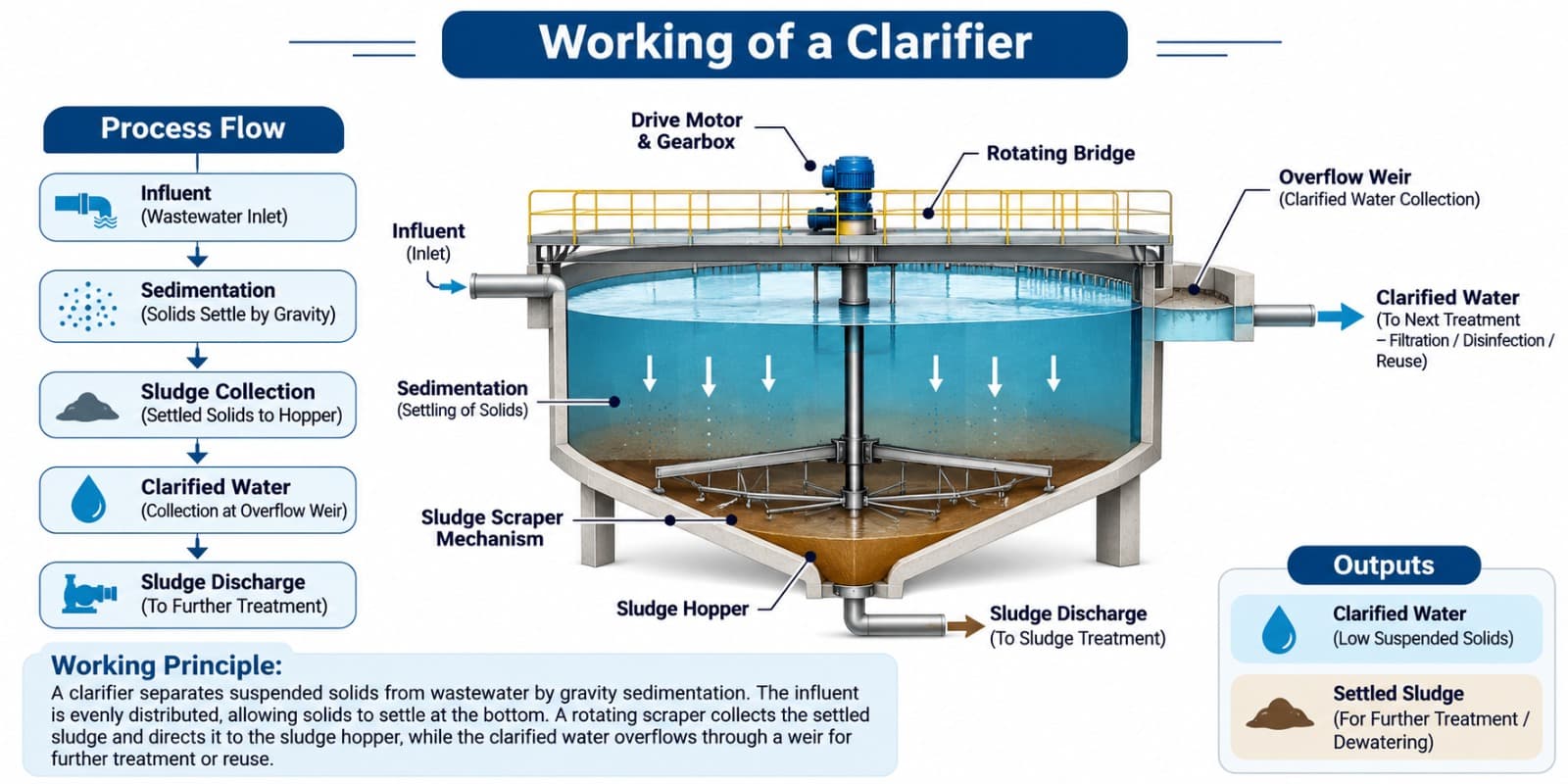
The wastewater enters the clarifier through an inlet distribution system designed to minimize turbulence and ensure uniform flow distribution. As the water moves slowly through the tank, suspended particles settle under gravitational force and accumulate at the bottom as sludge.
The settled sludge is collected and transferred towards the sludge collection pit or hopper using mechanical scrapers or sludge removal arrangements. Meanwhile, the clarified water rises towards the surface and flows over specially designed outlet weirs for further treatment or reuse.
The process generally involves the following stages:
1. Inlet Distribution:Wastewater is introduced into the clarifier through an inlet arrangement that distributes the flow uniformly.
2. Sedimentation: Suspended solids settle towards the bottom under gravity due to reduced water velocity.
3. Sludge Collection:Settled solids are collected using mechanical scraper mechanisms or suitable sludge removal systems.
4. Clarified Water Collection: Treated water is collected through peripheral or centrally arranged overflow weirs.
5. Sludge Discharge: Accumulated sludge is removed for further treatment, dewatering or disposal.
Types of Clarifiers
Depending on the application, wastewater characteristics, available space and treatment requirements, different types of clarifiers can be utilized.
1. Primary Clarifier
Primary clarifiers are installed at the initial stage of wastewater treatment to remove settleable suspended solids and floating matter before the biological treatment process.
They help reduce the organic and suspended solid load on downstream treatment equipment, improving the overall efficiency of the treatment plant.
2. Secondary Clarifier
Secondary clarifiers are generally installed after biological treatment processes such as activated sludge systems.
They separate biological sludge (activated sludge) from treated wastewater. The settled sludge can be partially recycled back into the aeration tank to maintain the required biomass concentration, while excess sludge is removed from the system.
3. Circular Clarifier
Circular clarifiers are widely used in industrial and municipal wastewater treatment plants. They typically consist of a circular tank, central feed arrangement, rotating bridge, mechanical scraper mechanism and sludge collection hopper.
Their design ensures uniform sedimentation, efficient sludge collection and continuous operation.
4. Lamella Clarifier
Lamella clarifiers utilize inclined plate or tube arrangements to increase the effective settling surface area within a compact footprint.
The inclined plates provide shorter settling distances, allowing suspended particles to settle efficiently. These systems are particularly suitable for applications where space availability is limited.
5. Rectangular Clarifier
Rectangular clarifiers are designed for applications requiring large-scale sedimentation capacity and efficient use of available plant space.
They generally incorporate chain-and-flight or mechanical scraper arrangements for collecting settled sludge and transferring it towards the sludge hopper.
Key Features and Advantages
- High Sedimentation Efficiency: Designed to promote effective settling of suspended solids and improve clarified water quality.
- Robust Mechanical Construction:Manufactured using suitable materials and components for reliable industrial operation.
- Efficient Sludge Removal: Equipped with suitable sludge scraping and collection arrangements.
- Continuous Operation: Designed to support uninterrupted treatment processes with appropriate mechanical configurations.
- Customizable Design: Available in different capacities, configurations and tank geometries according to project requirements.
- Reduced Downstream Load: Helps minimize suspended solids entering subsequent treatment stages.
- Low Maintenance Requirements: Engineered for convenient inspection, operation and routine maintenance.
- Space-Efficient Solutions:Lamella clarifier configurations can provide increased settling capacity within a compact footprint.
- Improved Water Quality: Supports consistent clarification performance for downstream filtration, disinfection and water reuse processes.
Major Components of Clarifiers
A typical clarifier system consists of the following components:
1. Clarifier Tank – The main structure where sedimentation takes place.
2. Inlet Feed Pipe – Introduces wastewater into the clarification system.
3. Inlet Distribution Well – Distributes incoming wastewater and reduces turbulence.
4. Central Shaft or Rotating Bridge – Supports the mechanical scraper arrangement, depending on the design.
5. Sludge Scraper Mechanism – Collects settled sludge from the tank bottom.
6. Drive Unit and Gearbox – Provides the required mechanical movement to the scraper assembly.
7. Sludge Hopper – Collects settled sludge for discharge.
8. Overflow Weirs – Facilitate uniform collection of clarified water.
9. Scum Removal Arrangement – Removes floating materials from the water surface, where provided.
10. Sludge Discharge Pipeline – Transfers collected sludge for further processing.
Industrial Applications
Clarifiers are extensively used across various industries and water treatment applications, including:
- Effluent Treatment Plants (ETP)
- Sewage Treatment Plants (STP)
- Water Treatment Plants (WTP)
- Zero Liquid Discharge (ZLD) Systems
- Chemical and Pharmaceutical Industries
- Textile and Dyeing Industries
- Food and Beverage Processing Plants
- Paper and Pulp Industries
- Power Plants and Cooling Water Systems
- Steel and Manufacturing Industries
- Municipal Wastewater Treatment Facilities
- Industrial Process Water Recycling Systems
Why Choose Terraquaer Clarifiers?
At Terraquaer Venture Private Limited, we understand that effective solid-liquid separation is a critical requirement for achieving consistent water and wastewater treatment performance.
Our clarifier solutions are developed with a focus on engineering reliability, process efficiency, operational convenience and long-term performance.
We emphasize application-specific equipment selection, suitable mechanical arrangements and customized configurations to meet the individual requirements of industrial and municipal treatment facilities.
From preliminary process requirements to equipment supply and installation support, we aim to provide dependable clarification solutions that contribute to efficient wastewater management and sustainable water recovery.
Frequently Asked Questions (FAQs)
1. What is the main purpose of a clarifier?
A clarifier is used to separate suspended solids from water through gravity sedimentation, producing clarified water and concentrated sludge.
2. What is the difference between a primary and secondary clarifier?
A primary clarifier removes settleable solids from raw wastewater before biological treatment, whereas a secondary clarifier separates biological sludge from treated wastewater after the biological treatment process.
3. Where are clarifiers used?
Clarifiers are commonly used in ETPs, STPs, WTPs, ZLD systems and various industrial wastewater treatment applications.
4. What is the function of a sludge scraper?
A sludge scraper collects settled solids from the bottom of the clarifier tank and directs them towards the sludge collection hopper for removal.
5. Can clarifiers be customized?
Yes. Clarifiers can be customized according to treatment capacity, wastewater characteristics, suspended solids concentration, site dimensions and specific process requirements.
6. What is the difference between a conventional and a lamella clarifier?
Conventional clarifiers primarily use the available tank surface area for sedimentation, whereas lamella clarifiers incorporate inclined plates to increase the effective settling area within a comparatively smaller footprint.
Gallery
Related products
Looking for something specific?
Tell us what you need to spec.
Share your capacity, compliance milestone, and timeline. An engineer responds within one business day.