Zero Liquid Discharge System
Integrated ZLD systems for high TDS wastewater, RO reject recovery, evaporator-crystallizer treatment and industrial effluent reuse.
Request a quote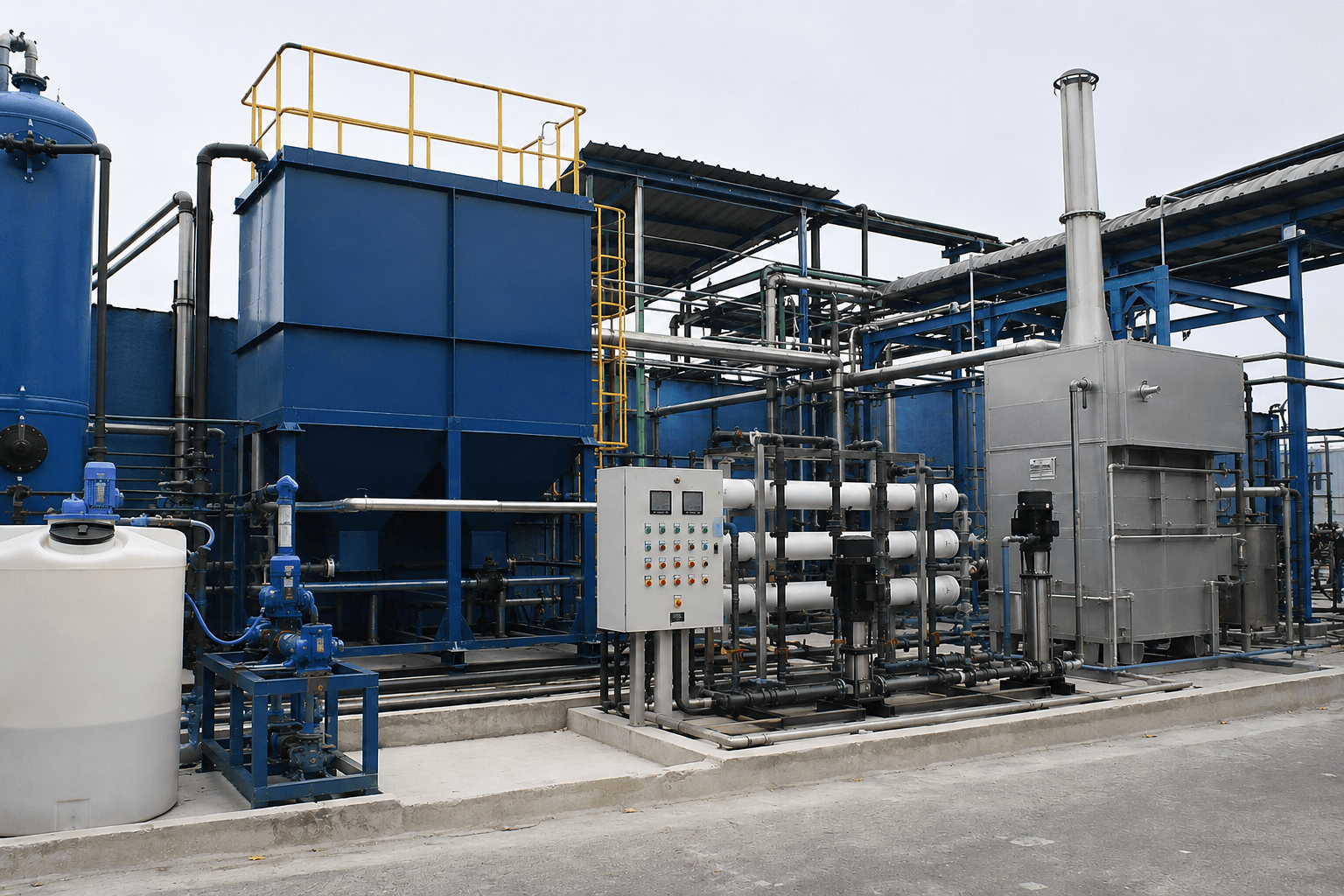
Overview
What Is a Zero Liquid Discharge System?
A Zero Liquid Discharge System, or ZLD system, is an integrated wastewater recovery and concentration plant designed to eliminate liquid effluent discharge from an industrial facility. Instead of sending high TDS wastewater, RO reject or process effluent outside the plant as liquid waste, the ZLD train recovers reusable water and converts the remaining dissolved and suspended solids into manageable sludge, wet salt or dry salt for approved handling. A complete ZLD system may include pretreatment, ultrafiltration, reverse osmosis, reject RO, evaporator integration, MEE or MVR, ATFD or crystallizer integration, condensate recovery, salt handling and sludge management.
Why ZLD Is Required
ZLD is required where liquid discharge is restricted, freshwater availability is limited, effluent contains high TDS, salts, colour, COD or difficult organics, or where maximum water recovery is needed for industrial reuse. It helps reduce discharge dependency, recover water back into process or utilities, reduce environmental risk and align plant operation with consent conditions or cluster-level disposal norms. For many industries, ZLD is selected not as a single machine but as a complete treatment philosophy combining chemical, membrane, thermal and solids-handling systems.
When It Is Selected
- When wastewater has high TDS, hardness, silica, colour, COD, organics or scaling tendency that prevents simple biological or tertiary discharge.
- When RO reject, softener regeneration waste, process blowdown or high-salinity effluent needs further recovery or concentration.
- When the plant must minimize or eliminate liquid discharge due to statutory, site, cluster or client sustainability requirements.
- When treated water reuse is economically or operationally important for process, cooling tower, boiler feed pretreatment or utility make-up.
- When an existing ETP or RO plant is producing reject that must be routed to MEE, MVR, ATFD or crystallizer systems.
Where ZLD Is Used
ZLD systems are used in chemical, dyes and intermediates, pharmaceutical, textile, food and beverage, dairy, refinery, petrochemical, power plant, automobile, metal finishing, electroplating, agrochemical, heavy engineering and industrial parks where high TDS wastewater or regulated effluent reuse is required. ZLD may be built as part of a new ETP or added as a downstream recovery and concentration package after biological, tertiary or membrane treatment.
How a ZLD System Works
- Equalization and pretreatment stabilize flow, pH, oil and grease, TSS, hardness, silica, colour, COD and scaling tendency before membrane or thermal treatment.
- Chemical treatment, clarification, DAF or media filtration reduce suspended solids, hardness, metals, organics or fouling load as required by the feed chemistry.
- UF or fine filtration protects downstream RO from colloids, turbidity and biological fouling.
- RO recovers low-TDS permeate for reuse while concentrating salts into reject stream.
- Reject RO, high-pressure RO or special membrane stages may recover additional water before thermal evaporation where feed chemistry permits.
- MEE or MVR evaporator integration concentrates the remaining brine and recovers condensate for reuse after polishing where required.
- ATFD or crystallizer integration converts concentrated brine into wet solids, dry salt or crystalline salt depending on design and disposal strategy.
- Sludge, salt and residual solids are dewatered, stored, packed or routed for approved disposal or recovery as per norms and salt quality.
Key Design Inputs
Final ZLD design depends on wastewater composition, TDS, hardness, silica, COD, organics, oil and grease, colour, pH, suspended solids, scaling tendency, evaporation load, recovery target, condensate reuse plan, utility availability, sludge and salt characteristics, operating hours, automation requirement and applicable disposal norms. Terraquaer does not treat ZLD as a fixed package; each system requires mass balance, water balance, salt balance, scaling review, utility review and lifecycle-cost evaluation.
Major Units and Scope Elements
- Pretreatment: equalization, pH correction, coagulation, flocculation, clarification, DAF, softening, antiscalant dosing, oxidation or organics reduction as required.
- Membrane block: UF, cartridge filtration, RO, reject RO, high recovery RO, CIP system, dosing system and membrane protection instruments.
- Thermal block: MEE, MVR, forced circulation evaporator, heat exchangers, vapour separator, condenser, condensate polishing and utility interfaces.
- Solids block: ATFD, crystallizer, centrifuge, filter press, screw press, salt handling, sludge dewatering and storage arrangement.
- Automation and utilities: PLC/SCADA, flow and conductivity monitoring, pressure and level instruments, steam, power, cooling water, compressed air and safety interlocks.
Terraquaer EPC / EPCC Approach
Terraquaer supports integrated ZLD projects through feasibility review, sampling and characterization, process selection, mass balance, water balance, salt balance, equipment selection, utility planning, layout coordination, automation philosophy, procurement, installation coordination, commissioning, performance tuning and O&M support. The EPC / EPCC approach connects ETP, UF, RO, reject RO, evaporator, crystallizer, condensate recovery, sludge handling and salt handling into one practical operating system instead of isolated equipment islands.
SEO, GEO and Internal Linking Signals
- Primary search intent: Zero Liquid Discharge System, ZLD system, high TDS wastewater treatment, RO reject treatment, MEE ZLD plant, MVR evaporator ZLD, ATFD crystallizer, condensate recovery and industrial effluent reuse.
- Recommended internal links: Effluent Treatment Plants, Industrial Reverse Osmosis Plants, Ultrafiltration System, Dual Media Filter, Activated Carbon Filters, Chemical Dosing Systems, Filter Press and Screw Press.
- Image alt text: Integrated ZLD system for high TDS wastewater with RO, evaporator, crystallizer and condensate recovery by Terraquaer.
- Schema-ready content: Product, Service, FAQPage, Organization and BreadcrumbList structured data can describe Terraquaer's ZLD design, EPC / EPCC supply, commissioning and O&M support.
CTA
Share your wastewater analysis, flow, TDS, hardness, silica, COD, organics, RO reject quantity, evaporation load, utility data and disposal norms with Terraquaer to develop an integrated ZLD concept, mass balance and EPC / EPCC execution plan.
Key features
- Integrated ZLD systems for high TDS wastewater, industrial effluent reuse and RO reject treatment.
- Pretreatment, UF, RO, reject RO, MEE/MVR, ATFD/crystallizer, condensate recovery and solids handling scope.
- Design based on wastewater composition, TDS, hardness, silica, COD, organics, scaling tendency and evaporation load.
- Condensate recovery and polishing support for process, utility or approved reuse applications.
- Salt, sludge and residual solids handling through crystallizer, ATFD, filter press, screw press or suitable dewatering route.
- Terraquaer EPC / EPCC support for process design, equipment selection, utility planning, automation, commissioning and O&M.
Key outcomes
- Maximum practical water recovery from industrial effluent and RO reject streams.
- Reduced or eliminated liquid discharge dependency for high TDS wastewater applications.
- Better integration between ETP, membrane, evaporator, crystallizer and solids handling systems.
- Improved reuse of recovered permeate and condensate where quality meets project requirements.
- Clearer operating control through mass balance, salt balance, utility planning and automation.
Standards & certifications
Designed with CPCB/SPCB consent conditions, disposal norms and site-specific standards; final ZLD configuration depends on detailed wastewater analysis and utility review.
Who it's for
Industrial plants, process manufacturers, EPC contractors, consultants and O&M teams handling high TDS wastewater, RO reject, regulated effluent reuse or ZLD compliance in chemical, textile, pharmaceutical, dyes, power, refinery, food, dairy, automotive, metal and agrochemical sectors.
Related products




Looking for something specific?
Tell us what you need to spec.
Share your capacity, compliance milestone, and timeline. An engineer responds within one business day.