Primary, Secondary, and Tertiary Treatment in ETP: What's the Difference?

1. Primary Treatment – Removing Physical Contaminants
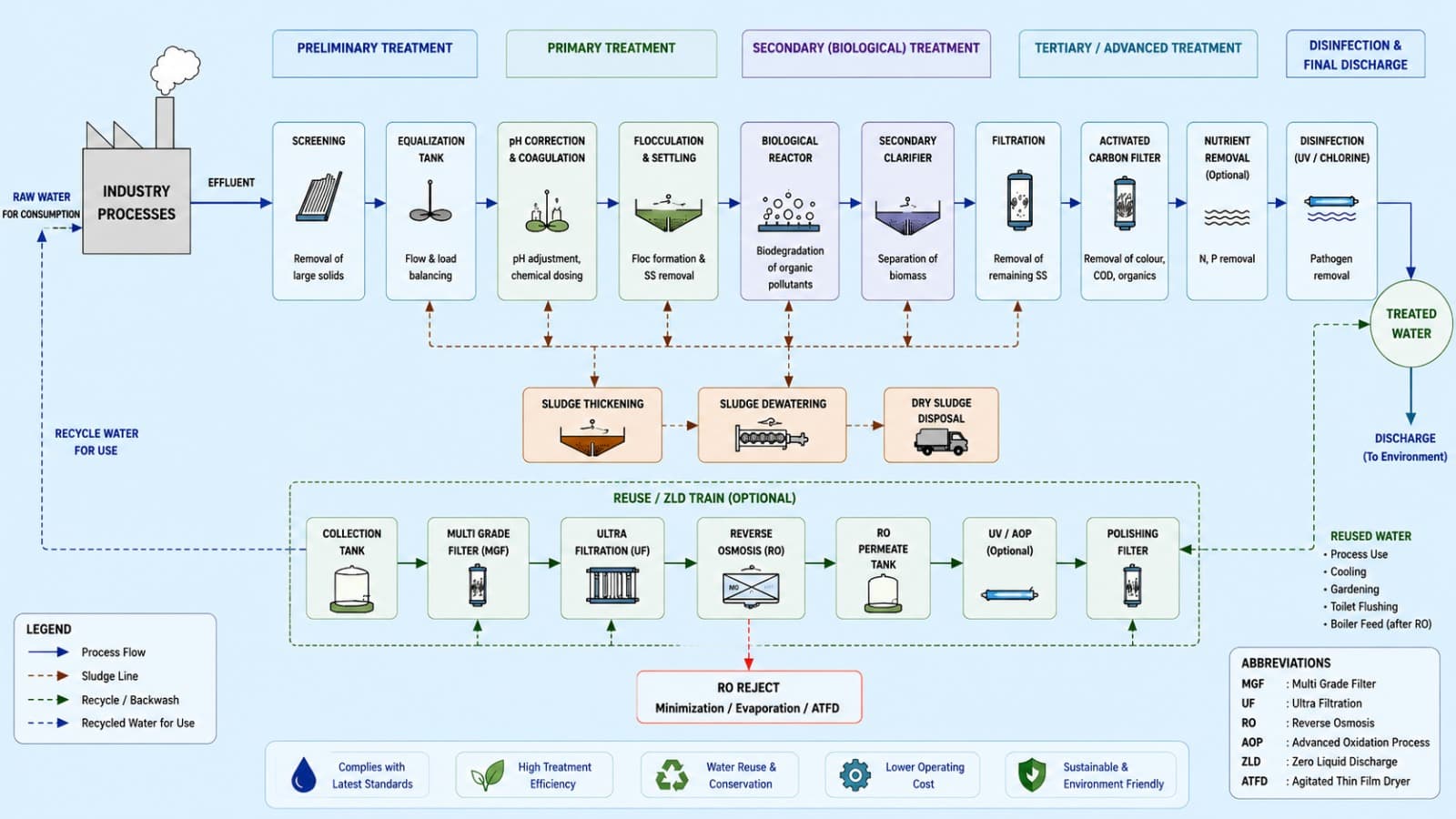
Primary treatment is the first stage of wastewater treatment. Its main objective is to remove large suspended solids, floating materials, oil, grease, and settleable particles through physical processes.
Common Processes
- Screening
- Grit removal
- Oil and grease separation
- Equalization
- Primary sedimentation
What It Removes
- Floating debris
- Sand and grit
- Suspended solids
- Oil and grease
Why It Matters
Removing these contaminants protects downstream equipment, reduces the load on biological treatment, and improves overall plant performance.
2. Secondary Treatment – Biological Removal of Organic Pollutants
After physical impurities are removed, the wastewater enters the secondary treatment stage. Here, naturally occurring microorganisms break down dissolved and biodegradable organic matter.
Common Processes
- Activated Sludge Process (ASP)
- Moving Bed Biofilm Reactor (MBBR)
- Sequential Batch Reactor (SBR)
- Membrane Bioreactor (MBR)
- Aeration systems
What It Removes
- Biodegradable organic matter
- Biochemical Oxygen Demand (BOD)
- Chemical Oxygen Demand (COD)
- Some nutrients
Why It Matters
Secondary treatment significantly improves water quality and is responsible for the majority of pollutant removal in an ETP.
3. Tertiary Treatment – Polishing for Discharge or Reuse
Tertiary treatment is the final polishing stage. It removes the remaining fine particles, dissolved contaminants, nutrients, microorganisms, and colour to achieve the required discharge or water reuse standards.
Common Processes
- Pressure Sand Filter (PSF)
- Activated Carbon Filter (ACF)
- Ultrafiltration (UF)
- Reverse Osmosis (RO)
- UV or Chlorine Disinfection
What It Removes
- Fine suspended solids
- Residual colour
- Dissolved salts (where required)
- Pathogens
- Remaining contaminants
Why It Matters
This stage ensures the treated water meets regulatory standards and can often be reused for industrial processes, reducing freshwater consumption.
Why Every Stage is Important
Skipping or underperforming any treatment stage can affect the entire plant. For example:
- Poor primary treatment increases the load on biological systems.
- Inefficient secondary treatment results in higher BOD and COD levels.
- Inadequate tertiary treatment may prevent compliance with discharge standards or water reuse requirements.
An efficiently designed and well-operated ETP depends on all three stages working together.
Practical Checklist for Plant Operators
- Monitor inlet wastewater characteristics regularly.
- Remove sludge and floating oil from primary units on schedule.
- Maintain proper dissolved oxygen levels in biological reactors.
- Inspect pumps, blowers, and aeration systems routinely.
- Clean and maintain filters and membranes as recommended.
- Test treated water quality periodically to ensure compliance.
Conclusion
Primary, Secondary, and Tertiary treatment are not independent processes—they are interconnected stages that together deliver effective wastewater treatment. Understanding the role of each stage helps industries improve treatment efficiency, reduce operating costs, protect equipment, and comply with environmental standards.
At Terraquaer, we believe that better understanding leads to better plant performance. Whether you're operating an existing ETP or planning a new treatment system, knowing the fundamentals is the first step toward reliable and sustainable wastewater management.