Mass Balance in Environmental Engineering: Why It Matters for Water and Wastewater Treatment

What is mass balance in environmental engineering?
Mass balance is one of the most fundamental tools used to understand how water, chemicals, solids, and pollutants move through an industrial process. In simple terms, it checks whether everything entering a system can be accounted for through treated output, waste output, reaction, reuse, loss, or accumulation.
The basic equation is: Input + Generation = Output + Accumulation. For environmental engineering, this equation becomes the backbone of water balance, wastewater load calculation, chemical dosing, sludge estimation, recycle planning, and zero liquid discharge design.
Why mass balance matters for Indian industries
For industries across India, mass balance is not just an engineering calculation. It is a practical method for improving sustainability, lowering operating cost, supporting CPCB and SPCB compliance, and building confidence that an ETP, STP, RO plant, MEE system, or ZLD scheme is working as intended.
By applying mass balance, industries can track resource consumption accurately, identify losses, leaks, bypasses, and inefficiencies, improve wastewater treatment performance, support regulatory documentation, reduce environmental impact, and enable better resource recovery and reuse.
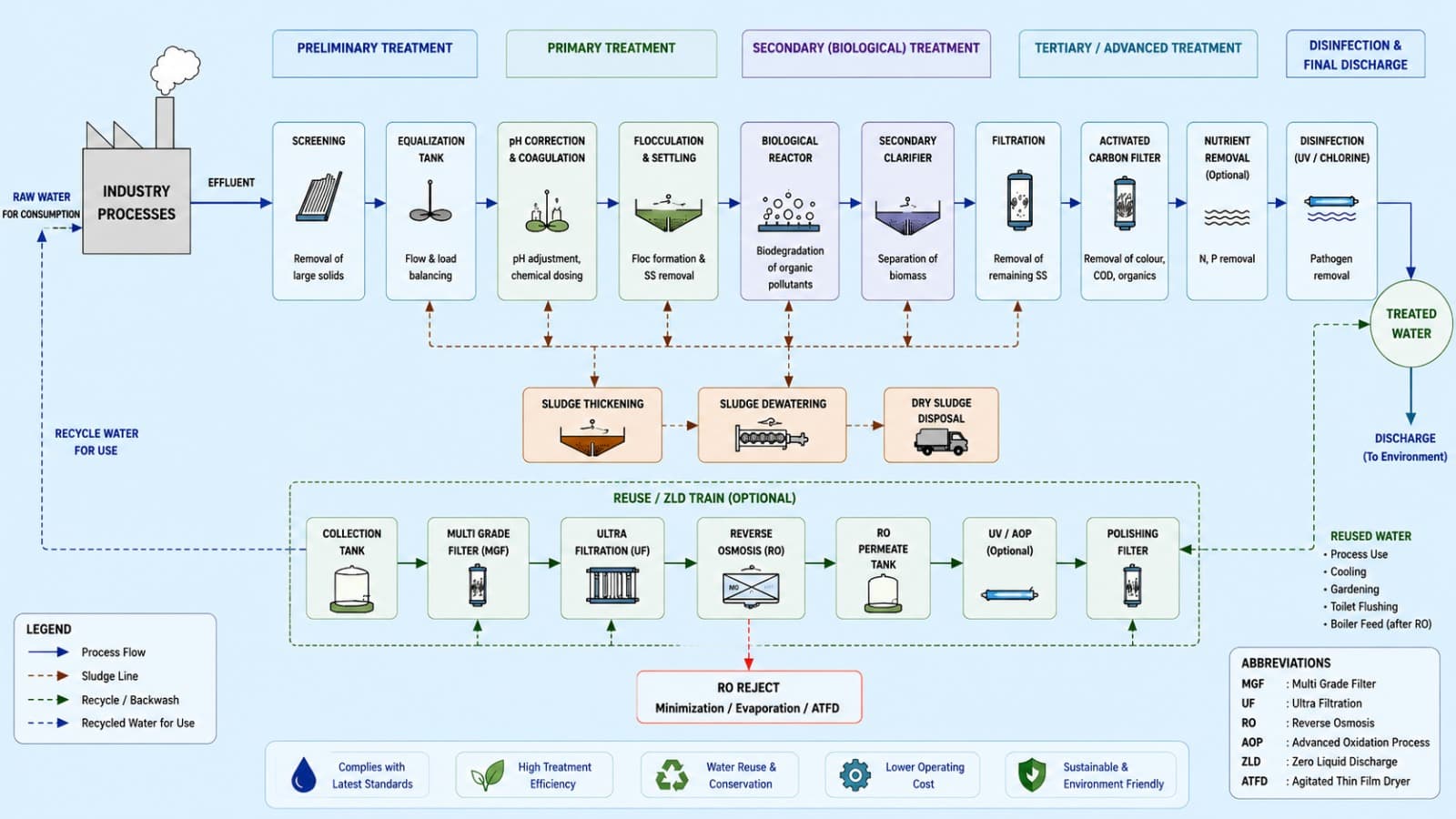
How mass balance is used in ETP, STP, RO, MEE, and ZLD systems
In an effluent treatment plant, mass balance compares raw effluent flow, COD, BOD, TSS, oil and grease, TDS, chemicals, sludge, treated water, and disposal streams. This helps engineers confirm whether pollution load reduction is happening in the right unit operations and whether any section is overloaded.
In sewage treatment plants, it supports hydraulic loading, biological treatment sizing, nutrient removal, sludge generation, and treated water reuse planning. In RO and ZLD systems, it becomes even more critical because permeate recovery, reject flow, evaporator feed, condensate, and salt output must match the design basis.
Common problems mass balance can reveal
A well-prepared water and pollutant mass balance can quickly expose hidden dilution, unmetered fresh water use, chemical over-dosing, abnormal sludge production, poor recovery in RO plants, high evaporation losses, missing recycle streams, illegal bypass risk, or inaccurate flow measurement.
These findings are valuable during plant design, consent applications, pollution control board inspections, environmental audits, process troubleshooting, capacity expansion, and sustainability reporting.
Mass balance and compliance with CPCB/SPCB requirements
Regulators and auditors often look for clear records of water intake, product use, wastewater generation, treated effluent quality, discharge quantity, sludge disposal, and reuse. Mass balance connects these numbers into one logical story, making it easier to justify consent conditions, pollution load reduction, and ZLD or reuse claims.
For high-impact sectors such as chemical, pharmaceutical, textile, dyes and intermediates, food and beverage, dairy, power, and heavy engineering, this documentation can be the difference between reactive troubleshooting and proactive environmental management.
How Terraquaer applies mass balance
At Terraquaer, we use mass balance principles to design smarter water, wastewater, and resource recovery solutions. Our engineering approach links inlet flow, pollutant load, chemical requirement, sludge handling, recycle potential, reject management, and treated water reuse into a practical design basis.
This helps industries choose the right treatment scheme, size equipment correctly, avoid under-designed systems, reduce lifecycle cost, and improve long-term compliance performance. Whether the requirement is ETP upgradation, STP design, RO reuse, MEE integration, or ZLD planning, mass balance gives the project a measurable foundation.
Key takeaway
Mass balance turns scattered plant data into an engineering decision tool. It helps industries understand where water and pollutants are going, why treatment performance changes, how much reuse is possible, and what must be corrected to achieve reliable environmental compliance.