
Improving Filter Channeling Performance in an Industrial Water Treatment Plant
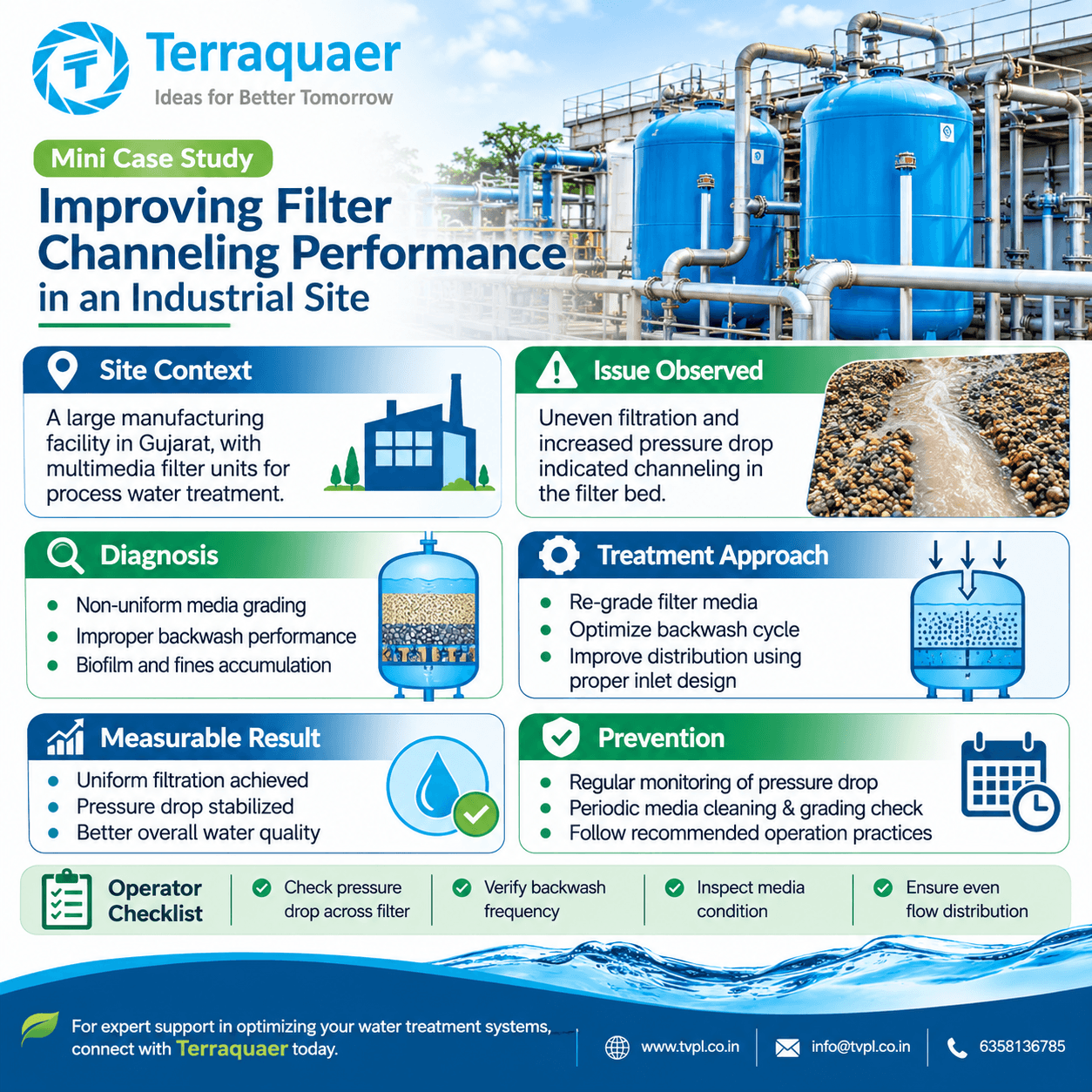
Focus: Improving filtration uniformity, reducing pressure variations, and maintaining treated-water quality.
1. Site Background – Understanding the Application
An industrial manufacturing facility in Gujarat operated a water treatment plant equipped with multimedia pressure filters for process-water treatment.
The filtration system used multiple layers of filter media, including:
- Silica sand
- Graded gravel
- Anthracite (where applicable)
The primary objective of the filtration system was to remove suspended solids, reduce turbidity, and provide consistent-quality water for downstream treatment processes.
Over time, the plant operators started observing variations in filtration performance, even though the filter system was operating under normal operating conditions.
2. Problem Observed – Uneven Filtration and Channel Formation
During routine operation, the plant experienced the following issues:
- Uneven water flow: Water was passing through certain portions of the filter bed more easily than others.
- Early breakthrough: Suspended particles were appearing in the filtrate before the expected filter run time.
- Pressure variations: Differential pressure across the filter showed irregular operating trends.
- Frequent backwashing: The operator had to perform backwashing more frequently.
- Inconsistent water quality: Treated-water turbidity showed fluctuations.
- Reduced filtration efficiency: The filter was not utilizing the entire media bed effectively.
These symptoms indicated possible filter-bed channeling, where water follows preferential flow paths instead of distributing uniformly through the filtration media.
3. Technical Diagnosis – Identifying the Root Causes
A systematic inspection of the filtration system was considered necessary to identify the actual causes.
The following areas were evaluated:
A. Filter Media Condition
- Checked media depth and layer arrangement.
- Inspected for media mixing and uneven grading.
- Evaluated the presence of accumulated suspended solids.
- Checked for media loss during backwashing.
B. Backwashing Performance
- Reviewed backwash flow rate and duration.
- Checked whether the bed expanded uniformly.
- Inspected backwash-water distribution.
- Evaluated whether insufficient washing was leaving solids within the media.
C. Inlet and Outlet Distribution
- Inspected inlet distributors for blockage or damage.
- Checked underdrain and nozzle condition.
- Evaluated the possibility of uneven water distribution.
D. Operating Conditions
- Reviewed filtration flow rate.
- Checked differential pressure trends.
- Compared inlet and outlet turbidity.
- Examined variations in raw-water quality.
Major suspected causes:
- Non-uniform media grading.
- Inadequate or uneven backwashing.
- Accumulation of fine particles and deposits.
- Improper inlet or underdrain distribution.
4. Corrective Treatment Approach – Restoring Uniform Filtration
Based on the inspection findings, a corrective maintenance and optimization plan was developed.
Step 1: Filter Media Inspection and Regrading
- Opened the filter vessel after safe isolation and depressurization.
- Inspected the condition and depth of each media layer.
- Removed accumulated deposits and unsuitable media where required.
- Replaced damaged or lost media.
- Restored the recommended media grading and layering.
Step 2: Backwash System Optimization
- Checked backwash pump performance.
- Verified backwash flow distribution.
- Adjusted backwash duration based on media characteristics and observed bed expansion.
- Ensured proper rinsing before returning the filter to service.
Step 3: Distribution System Inspection
- Inspected inlet distributors and internal piping.
- Checked underdrain laterals and nozzles for blockage or damage.
- Rectified identified distribution problems.
- Verified uniform flow distribution across the filter bed.
Step 4: Operating Parameter Optimization
- Reviewed filtration loading rate.
- Established operating limits for differential pressure.
- Set backwash initiation criteria based on pressure drop, filtrate quality, and maximum allowable run time.
- Standardized operating procedures for plant operators.
5. Performance Evaluation – Measuring the Improvement
After implementing the corrective measures, the filtration system should be monitored under comparable operating conditions to establish the actual improvement.
The following performance indicators are recommended:
Performance ParameterBefore CorrectionAfter Correction
Filtrate turbidity
Fluctuating
Record stabilized value
Differential pressure
Irregular trend
Record stabilized trend
Filter run time
Frequent backwashing
Record revised run time
Backwash frequency
Higher than expected
Record revised frequency
Media condition
Uneven/deposited
Corrected and inspected
Filtration distribution
Suspected channeling
Verify uniformity
Expected operational benefits (subject to site verification):
- More uniform water distribution through the filter bed.
- Improved suspended-solids removal.
- Better control of filtrate turbidity.
- Reduced unnecessary backwashing.
- Improved utilization of filter media.
- More consistent operation of downstream treatment units.
Note: Actual numerical improvements must be established using recorded plant operating data. The above is an illustrative case-study framework, not a verified client performance report.
6. Preventive Maintenance – Avoiding Future Channeling
To prevent recurrence, the following maintenance practices should be incorporated into routine plant operation.
Daily Checks
- Record inlet and outlet pressure.
- Monitor differential pressure.
- Check filtrate turbidity.
- Observe filter flow rate.
- Record backwashing activities.
Weekly Checks
- Review filter run time.
- Examine backwash performance.
- Check for unusual pressure variations.
- Review raw-water quality fluctuations.
Monthly / Periodic Checks
- Inspect media condition as per the maintenance schedule.
- Check internal distribution components during planned shutdowns.
- Evaluate media loss and bed depth.
- Review filter operating performance and maintenance records.
7. Key Learning – Importance of Proper Filter Operation
Filter channeling is not always caused by poor-quality filter media. It can also result from improper backwashing, uneven flow distribution, damaged internal components, or unsuitable operating conditions.
A systematic approach combining media inspection, hydraulic checks, backwash optimization, and routine monitoring helps maintain reliable filtration performance.
Operator Checklist
☐ Check differential pressure across the filter.
☐ Monitor inlet and outlet turbidity.
☐ Verify backwash flow and duration.
☐ Inspect media condition and bed depth periodically.
☐ Check inlet distributors and underdrain components.
☐ Maintain daily operating and backwash records.
Conclusion
Efficient filtration depends on more than the selection of filter media. Proper hydraulic distribution, correct backwashing, suitable operating conditions, and preventive maintenance are equally important.
Terraquaer supports industrial water-treatment applications through practical engineering, filtration-system optimization, equipment support, and operation and maintenance solutions.