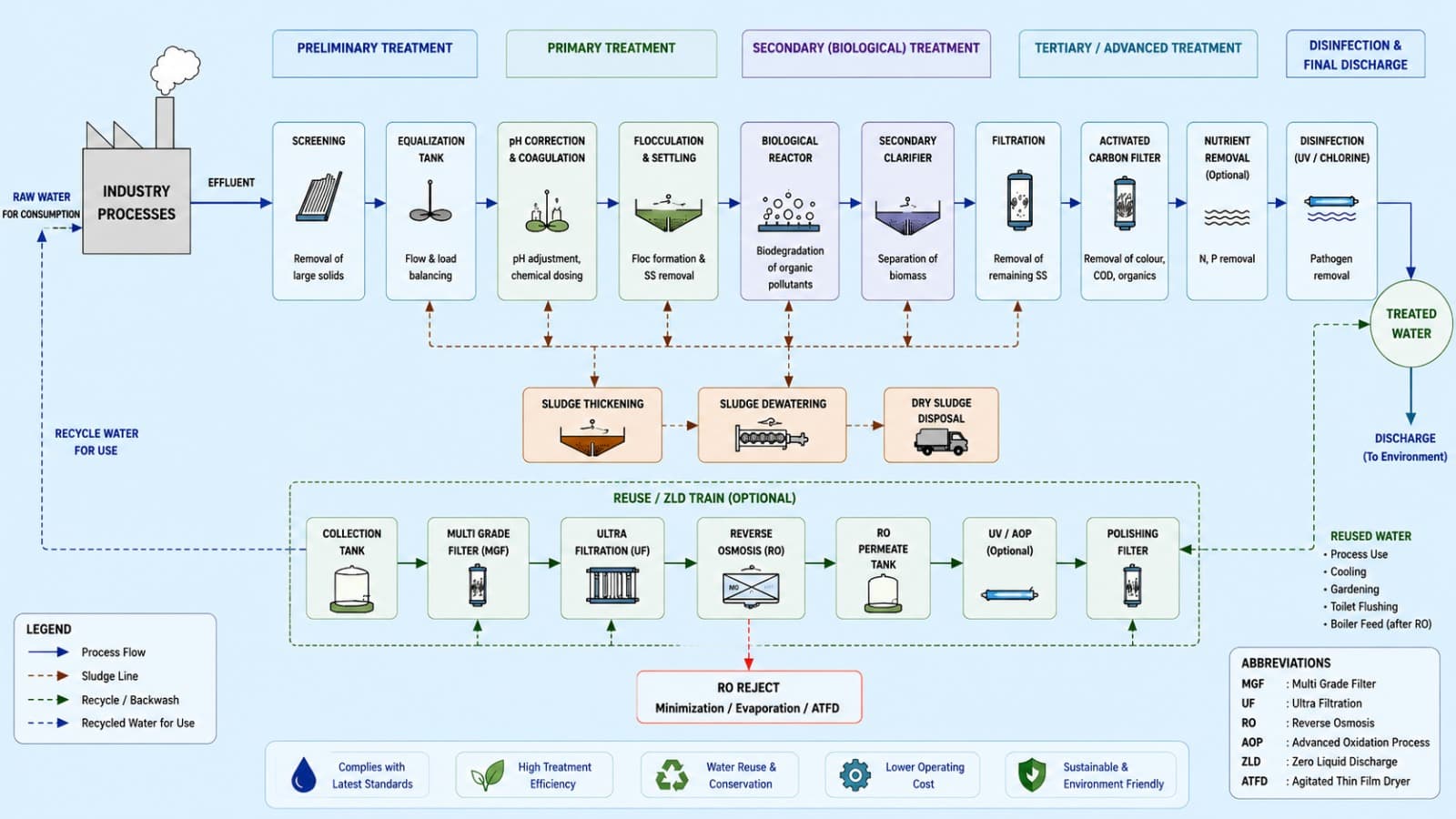
Filter Press vs Screw Press vs Centrifuge: Choosing Sludge Dewatering Equipment for ETP and STP
Sludge dewatering is not a final housekeeping step. It determines how much wet mass leaves an ETP or STP, how much filtrate returns to the plant, how frequently operators handle cake, and whether the selected disposal or recovery route remains practical. A machine that looks economical on purchase can become expensive when it is fed dilute sludge, poorly conditioned solids, or a variable load that was never tested.
For most industrial and institutional plants, the shortlist includes a filter press, screw press, centrifuge, belt press, or drying bed. This guide focuses on the three options most often compared for compact and medium-sized installations: filter press, screw press, and centrifuge. The correct choice comes from sludge data and the whole solids-management chain, not from a single promised cake-dryness number.
First separate STP sludge from industrial ETP sludge
Domestic sewage sludge and industrial effluent sludge can behave very differently. Biological STP sludge is often compressible and sensitive to conditioning. Industrial ETP sludge may contain metal hydroxides, lime, pigments, fibres, oils, salts, or process chemicals. Two plants with the same hydraulic capacity can therefore have very different dry-solids loads and dewatering behaviour.
The disposal decision is equally important. Stabilised sewage biosolids may have beneficial-use routes only after applicable quality, pathogen, and contaminant requirements are met. Industrial ETP sludge or filter cake may fall under hazardous-waste controls depending on its source and characteristics. Dewatering changes volume and handling; it does not automatically make sludge non-hazardous or suitable for land application.
The data needed before comparing machines
Start with a representative sludge sample and an operating mass balance. Flow in kilolitres per day is not enough. The dewatering unit must be sized against kilograms of dry solids per day, peak production, feed concentration, operating window, and the destination of both cake and separated liquid.
- Sludge source: primary clarifier, biological excess sludge, chemical precipitation, tertiary treatment, RO or softening residual, or a mixed stream.
- Average and peak wet-sludge flow, feed total solids, volatile solids where relevant, and calculated dry-solids load.
- Particle size, compressibility, oil and grease, fibres, abrasiveness, salinity, pH, temperature, and chemical compatibility.
- Bench or pilot conditioning results for polymer, coagulant, lime, or filter aid, including dose, floc quality, filtrate clarity, and cake release.
- Required operating hours, batch pattern, redundancy, available floor height, ventilation, wash-water supply, drainage, and operator availability.
- Target cake handling route: trolley, bag, skip, conveyor, covered storage, authorised transporter, further drying, recovery, or disposal.
- Return-liquor destination and its likely suspended-solids, ammonia, COD, salinity, or chemical load on the head of the plant.
Filter press: best when cake dryness and filtrate clarity lead the decision
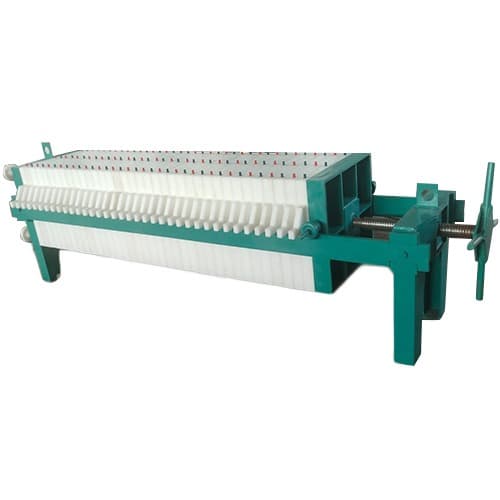
A filter press is a pressure-driven batch process. Conditioned sludge is pumped into chambers between cloth-covered plates. Filtrate passes through the cloth while solids build into cake; the press is then opened and cake is discharged. Recessed-chamber presses are common, while membrane plates add a squeeze stage where lower residual moisture or shorter cycles justify it.
Filter presses are often strong candidates for chemical, pharmaceutical, dyes, textile, metal-finishing, mineral, and other industrial sludges where batch operation is acceptable and a firm cake is valuable. They can also serve STPs, especially where the solids load is intermittent and operators can manage cycles.
- Strengths: potentially firm cake, good filtrate clarity when cloth and conditioning are correct, broad material and cloth options, and a familiar batch workflow.
- Trade-offs: cycle time, plate opening and cake discharge, cloth washing, feed-pump control, hydraulic maintenance, and more hands-on intervention on manual units.
- Watch for: blind cloth, uneven chamber filling, leaking plate seals, sticky cake, short-circuiting, pressure spikes, and filtrate that is returned without checking its effect on the process.
Screw press: best when continuous, low-speed operation and simple routines matter
A screw press normally combines flocculation, gravity drainage, and gradual compression along a slow-moving screw. It can run continuously, has a compact footprint, and generally uses less rotational speed than a centrifuge. It is attractive for biological sludge where reliable polymer conditioning is available and the plant values steady automatic operation.
Its performance depends heavily on sludge rheology, feed-solids stability, polymer selection, screen condition, back-pressure control, and wash routines. Fine or difficult industrial solids should be tested rather than assumed to behave like municipal biological sludge.
- Strengths: continuous operation, low-speed drive, compact layout, relatively simple automatic sequencing, and reduced operator handling when feed conditions are stable.
- Trade-offs: polymer dependency, sensitivity to poorly formed floc, screen washing, possible loss of fine solids, and cake dryness that may be lower than a well-selected filter press for some sludges.
- Watch for: variable feed concentration, overdosing that produces slippery cake or high cost, blocked screens, worn screw or spacers, wash-water failure, and filtrate solids recycling to the biological process.
Centrifuge: best when throughput, enclosed operation, and continuous separation dominate
A decanter centrifuge uses high rotational force and a differential-speed scroll to separate solids continuously. A bag centrifuge is different: it is a batch basket machine lined with a filter bag and is better suited to smaller, intermittent sludge loads. Both use centrifugal force, but their capacity, controls, discharge method, and maintenance model are not interchangeable.
Decanters can deliver high throughput in a compact enclosed machine, but they need skilled maintenance, vibration control, wear protection, energy, polymer optimisation, and disciplined start-up and shutdown. Bag centrifuges can offer a simpler lower-capacity route where the operator can stop the basket and remove the cake-filled bag.
- Strengths: compact high-throughput separation for decanters; enclosed operation; quick response to controlled feed; practical batch separation at smaller scale for bag centrifuges.
- Trade-offs: higher rotational energy and maintenance for decanters, wear on abrasive sludge, specialist balancing and service requirements, and sensitivity to polymer and differential-speed settings.
- Watch for: vibration, bearing temperature, scroll torque, abrasive wear, unstable feed, solids carryover, unsafe access to rotating equipment, and overconfident dryness claims made without a site trial.
Filter press vs screw press vs centrifuge: practical selection logic
Choose a filter press when a batch process is acceptable, cake release can be managed, and the business case rewards firmer cake or clearer filtrate. Choose a screw press when biological sludge, continuous low-speed operation, compact automation, and predictable polymer conditioning align. Consider a decanter centrifuge when continuous high throughput, enclosure, and footprint justify higher energy and specialist maintenance. Consider a bag centrifuge for lower, intermittent loads where simple batch removal fits the operating routine.
No comparison is complete without lifecycle cost. Evaluate installed electrical load, polymer and conditioning chemicals, wash water, compressed air, cloths or screens, wear parts, operator hours, service skills, downtime, standby capacity, cake transport mass, and the treatment cost of return liquor. The lowest capital price is rarely the lowest cost per tonne of dry solids handled.
Why cake dryness alone can mislead
Cake dryness varies with sludge type, feed concentration, conditioning, machine settings, cycle time, temperature, and test method. A percentage quoted for one sludge cannot be transferred to another plant. More importantly, a small improvement in solids percentage may have a large or small transport benefit depending on daily dry-solids production and disposal pricing.
Use a trial to calculate wet cake mass per day, dry-solids capture, filtrate quality, chemical dose per kilogram of dry solids, operating hours, and disposal trips. A valid guarantee should define the sample basis, feed conditions, averaging period, test method, utilities, and exclusions.
Return liquor can quietly overload the treatment plant
Filtrate, centrate, or press liquor is usually routed back to an equalisation tank or headworks, but this recycle is not free. It can return suspended solids, soluble COD, ammonia, phosphorus, salts, or conditioning chemicals. Poor capture simply moves the solids from the dewatering room back into the process.
The design should therefore include controlled return flow, sampling points, isolation, drainage, overflow protection, and a defined destination. Operators should trend feed solids, cake solids, capture rate, polymer dose, return-liquor quality, run hours, and abnormal events. The CPHEEO operation guidance specifically warns that inadequate thickening and high-solids centrate can reduce downstream treatment performance.
Compliance and cake handling must be designed together
For sewage sludge, stabilisation, contaminant quality, pathogen control, storage, transport, and the approved end-use or disposal route must be considered as one system. For industrial ETP sludge, classification and authorisation should follow the applicable consent conditions and the Hazardous and Other Wastes framework where relevant. Covered storage, impervious floors, leachate collection, labelling, records, and authorised movement may be required by the site-specific approval.
Do not select a machine on the assumption that dewatered cake can be sold, composted, land-applied, or sent with municipal waste. Confirm the route with representative analysis and the competent pollution-control authority. The current MoEFCC rules and CPCB waste-utilisation SOPs should be checked alongside the plant's Consent to Establish, Consent to Operate, environmental clearance, and local directions.
A commissioning acceptance test that protects the buyer
- Run the agreed representative sludge, not clean water or a specially prepared one-off batch.
- Measure feed flow and feed solids so dry-solids loading is known.
- Record polymer or other conditioning dose on a dry-solids basis.
- Measure cake solids, filtrate suspended solids, solids capture, throughput, power, wash water, and cycle or run time.
- Verify safe interlocks, guards, emergency stops, drainage, odour control, noise or vibration limits, and access for maintenance.
- Demonstrate start-up, shutdown, cleaning, cake discharge, upset recovery, and operator handover.
- Repeat testing long enough to cover normal variability and document the guarantee basis, sampling method, and laboratory method.
Common reasons sludge dewatering underperforms
- The machine was sized on plant KLD instead of dry-solids load.
- Sludge thickening was omitted, so the equipment processes excess water and misses capacity.
- Polymer selection was copied from another site without jar, drainage, or pilot trials.
- Primary, biological, and chemical sludges were mixed without checking how the blend dewaters.
- Return liquor was sent back as an uncontrolled shock load.
- Cake storage, trolley movement, bagging, lifting, or truck access was designed after the machine.
- Wash-water pressure, cloth or screen cleaning, spares, and preventive maintenance were underestimated.
- Operators were given a single setpoint rather than a control range tied to feed-solids changes.
How Terraquaer supports a complete sludge-handling package
Terraquaer can evaluate the sludge source, mass balance, thickening need, conditioning trials, machine selection, cake and filtrate handling, utilities, automation, safety, and the final approved management route. The scope can be delivered as equipment supply, EPC or EPCC integration, plant revamping, commissioning, performance testing, operator training, and lifecycle O&M support.
The objective is not simply to install a dewatering machine. It is to produce a repeatable solids-handling system that fits the ETP or STP, protects treatment performance, reduces avoidable wet mass, and leaves a documented operating and compliance trail.
Related Terraquaer pages
- Filter Press: /products/filter-press
- Screw Press: /products/screw-press
- Bag Centrifuge: /products/bag-centrifuge
- Effluent Treatment Plants: /products/effluent-treatment-plants
- Sewage Treatment Plant: /products/sewage-treatment-plant
- Water and Wastewater Plant O&M: /solutions/operation-maintenance-of-water-wastewater-treatment-plants
Reference framework used for this guide
This article was informed by the Government of India's CPHEEO Manual on Sewerage and Sewage Treatment Systems, including its sludge-treatment design and O&M chapters; MoEFCC's current Hazardous and Other Wastes rules and amendments; CPCB hazardous-waste utilisation SOP material; and US EPA biosolids technology fact sheets for belt filters, recessed-plate filter presses, centrifuges, and other dewatering technologies. Project decisions must still be checked against current site-specific approvals and representative sludge testing.